Key facts most searched about the death adder:
- The death adder is not a true viper or adder at all, since it belongs to the family Elapidae, and its adder-like body shape is a result of convergent evolution.
- Before antivenom existed, the Australian Museum reports that around 60 percent of death adder bites to humans were fatal, and the species is recognized as the fastest striking venomous snake in Australia.
- There are seven recognized death adder species native to Australia, with conservation status ranging from Least Concern to Vulnerable depending on the species and its range.
Few Australian snakes carry a name as ominous as the death adder, yet much of what makes this genus interesting has nothing to do with its unsettling reputation. This guide covers what is documented about the death adder's classification, strike speed, venom, hunting behavior, habitat, and conservation status, drawing on information from the Australian Museum, Australian Geographic, and university based venom research groups.
Quick Summary Table
| Category | Detail |
|---|---|
| Scientific name (common species) | Acanthophis antarcticus |
| Genus | Acanthophis (seven Australian species recognized) |
| Family | Elapidae (not Viperidae, despite the adder-like body shape) |
| Average adult length | Around 50 cm, occasionally up to 100 cm |
| Body shape | Short, stocky body with a triangular head and narrow neck |
| Venom type | Potent neurotoxin affecting nerve and muscle function |
| Historical untreated fatality rate | Approximately 60 percent before antivenom |
| Strike speed | Fastest strike of any venomous snake in Australia |
| Diet | Lizards, frogs, small mammals, and birds |
| Hunting style | Ambush predator using caudal luring with its tail tip |
| Range | All mainland Australian states and territories; some species in Papua New Guinea and nearby islandsantarcticus |
| Conservation status | Varies by species, from Least Concern to Vulnerable |
What Is a Death Adder? Classification Explained
The death adder belongs to the genus Acanthophis, part of the family Elapidae, which places it in the same broad group as Australia's other front-fanged venomous snakes, including brown snakes, tiger snakes, and black snakes. This classification often surprises people, since the death adder's short, thick body and triangular head look far more like a European viper than a typical elapid. That resemblance is a textbook case of convergent evolution: two unrelated snake lineages, vipers in Europe and Asia and death adders in Australia and New Guinea, independently evolved similar body shapes because both groups adopted the same ambush and wait hunting strategy.
Unlike true adders and vipers, which are not native to Australia at all, death adders are true elapids, more closely related to cobras than to any European adder.
Why Is It Called a Death Adder?
The name is one of the most searched questions about this species, and the real explanation is more interesting than a simple reference to lethality. Death adders behave differently from most Australian snakes in one key way: rather than fleeing when a person or predator approaches, they typically stay perfectly still and rely on camouflage to avoid detection. According to a widely cited account from Australian venom researchers, this unusual refusal to move when danger nears led early observers to nickname it a deaf adder, under the assumption that the snake simply could not hear approaching threats. Over time, that nickname is believed to have shifted into the current name, death adder, rather than the name being coined purely to describe how dangerous the species is.
Death Adder Venom: How Dangerous Is a Bite?
Death adder venom is a potent neurotoxin that disrupts the normal function of nerves and muscles, and it carries relatively large fangs capable of delivering a substantial dose in a single strike. Before antivenom became available, the Australian Museum reports that around 60 percent of death adder bites to humans proved fatal, a rate that places the genus among the more historically dangerous snakebites documented in Australia. Bite symptoms typically include pain and swelling at the site, blurred vision, and progressive muscle weakness that can advance to respiratory distress if the venom load is significant and untreated.
Modern antivenom has changed outcomes dramatically, and confirmed deaths from death adder bites in Australia are now rare when medical care is sought quickly. That said, the historical fatality rate underscores why any suspected bite should always be treated as a medical emergency rather than something to monitor at home.
How Fast Does a Death Adder Strike?
Despite a stocky body that looks slow and sluggish, the death adder is recognized as the fastest striking venomous snake in Australia, launching its attack in a fraction of a second once prey comes within range. This speed is concentrated entirely in the strike itself rather than in general movement or fleeing ability, which fits the species' overall strategy of remaining motionless for long periods and relying on a single explosive strike rather than any form of pursuit.
How Does a Death Adder Hunt? Camouflage and Caudal Luring
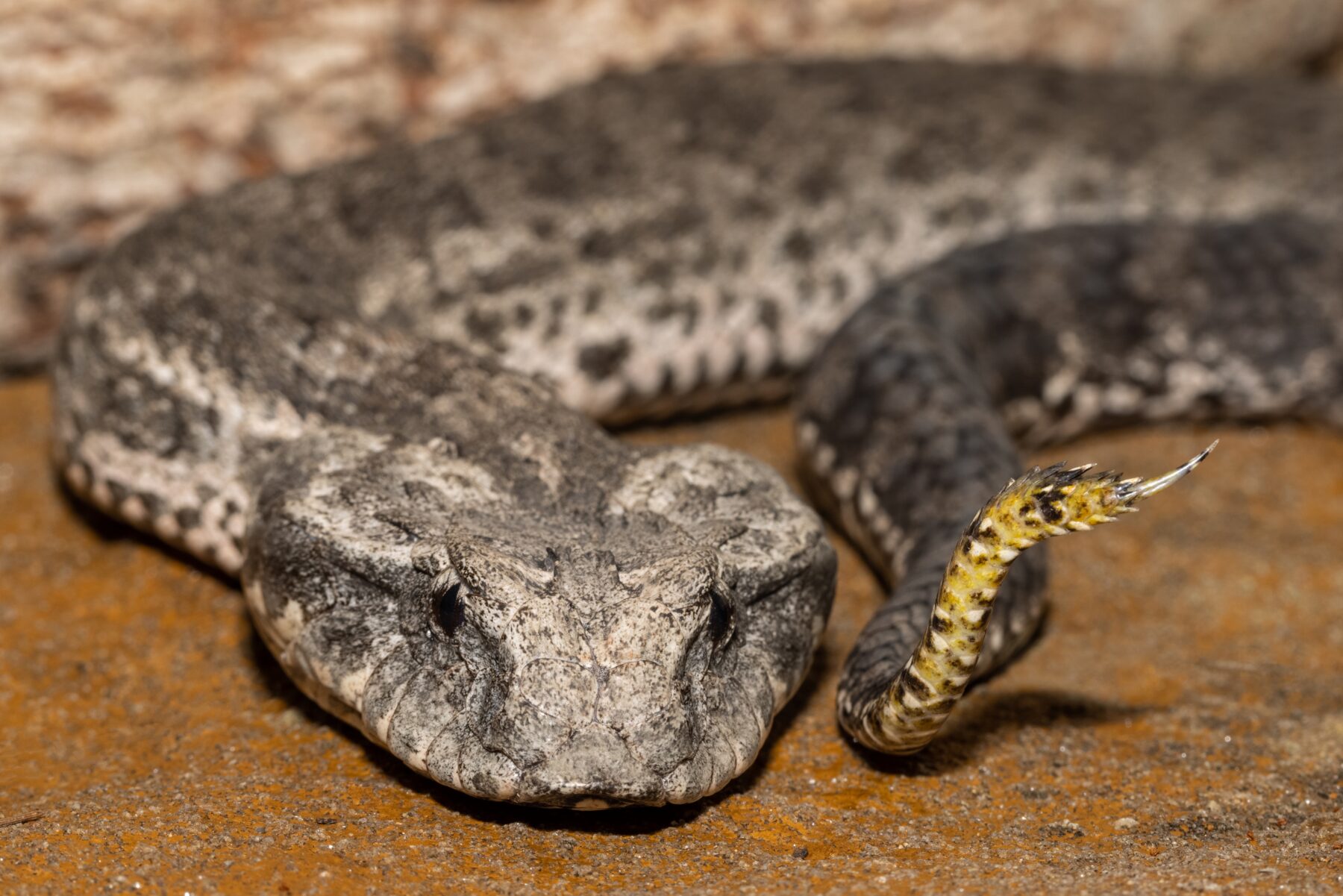
Death adders are classic ambush predators. A death adder typically buries itself partly in loose soil, sand, or leaf litter, remaining almost invisible thanks to its banded, cryptic coloring, and can wait in the same spot for extended periods, sometimes many days, until suitable prey passes close by. To speed up the process, the snake uses a hunting technique called caudal luring, twitching the thin, worm-like tip of its tail near its own head to mimic the movement of a small grub or insect.
When a curious lizard, frog, small mammal, or bird approaches to investigate the moving tail tip, the death adder strikes with remarkable speed, injects venom, and then waits nearby for the prey to succumb before swallowing it whole. This combination of extreme patience and explosive strike speed makes the death adder one of the most specialized ambush hunters among Australian snakes.
How to Identify a Death Adder
Death adders have a short, stocky body compared to most Australian snakes, a broad, arrow-shaped or triangular head, and a distinctly narrow neck that separates the head from the body. Most individuals measure under 100 centimeters, with common death adders often closer to 50 centimeters, and adult coloring typically includes reddish, brown, or gray crossbands along the back paired with a lighter cream, gray, or pink underside. The tail ends in a thin, curved, worm-like tip used specifically for luring prey, a feature not seen in most other Australian elapids.
Where Do Death Adders Live? Habitat and Range by Species
Collectively, death adders occupy an unusually wide habitat range for a single genus, spanning rainforest, open woodland, grassland, coastal heath, and arid desert, depending on the specific species. Death adders occur in every mainland Australian state and territory, and additional species are found in Papua New Guinea and nearby islands.
The common death adder favors forests, woodlands, grasslands, and heathland across much of eastern and coastal southern Australia, including Queensland, New South Wales, Victoria, and South Australia. Other species are far more habitat specific, such as the desert death adder, adapted to genuinely arid, sandy interior habitat, and the Barkly Tableland death adder, restricted to flat, treeless floodplain habitat in northern Australia.
How Many Species of Death Adder Are There?
There are seven recognized death adder species native to Australia: the common death adder, the northern death adder, the desert death adder, the Kimberley death adder, the Barkly Tableland death adder, the Pilbara death adder, and a species found in the Top End region, along with an additional species recognized in Papua New Guinea. Species boundaries within the genus Acanthophis have shifted repeatedly as researchers apply genetic analysis to previously assumed subspecies and regional populations, and taxonomic debate on exact classification continues among herpetologists.
Is the Death Adder Endangered? Conservation Status by Species
Conservation status varies considerably across the genus. The desert death adder is currently listed as Least Concern by the IUCN, reflecting its wide range across arid interior Australia, while the Barkly Tableland death adder is classified as Vulnerable due to its narrow, specific floodplain habitat requirements. The common death adder remains broadly widespread but has declined in parts of its historic range.
The most significant emerging threat across the genus is the spread of invasive cane toads throughout northern and eastern Australia. Because death adders are ambush predators that strike at almost any suitably sized moving animal that wanders within range, including cane toads, and because they have no evolutionary history of avoiding this introduced species, many die after biting and swallowing a toad whose skin toxins are lethal to native predators. Habitat clearing and degradation for agriculture and grazing add further pressure in several regions.
Death Adder vs Other Snakes: How It Really Compares
Death Adder vs European Adder (True Viper)
The European adder, Vipera berus, belongs to the family Viperidae and is only distantly related to the Australian death adder, which is a member of Elapidae. The two look similar because both evolved a stocky ambush predator body plan independently, a case of convergent evolution rather than shared ancestry. Elapid venom, including death adder venom, is primarily neurotoxic, while viper venom typically leans more heavily on hemotoxic and cytotoxic effects, meaning the underlying biology of a bite from each snake works quite differently despite the superficial resemblance.
Death Adder vs Eastern Brown Snake
The eastern brown snake is far more active and fast moving overall, actively pursuing prey and covering considerable ground, while the death adder relies almost entirely on staying still and luring prey to it. Eastern brown snake venom is considered more toxic milligram for milligram and is responsible for a much higher number of serious snakebite cases in Australia each year, largely because the species is more frequently encountered near populated areas, while death adders are bitten less often thanks to their camouflage based, sedentary lifestyle, even though a death adder bite carries a historically severe untreated fatality rate of its own.
Frequently Asked Questions About the Death Adder
Is the death adder actually a type of adder or viper?
No, the death adder is not a true adder or viper at all. It belongs to the family Elapidae, the same family as cobras, mambas, and coral snakes, rather than the family Viperidae, which includes true adders and vipers and does not naturally occur in Australia. The stocky body, triangular head, and ambush hunting style that make it resemble a European adder are the result of convergent evolution, meaning two unrelated snake lineages independently evolved similar body shapes because they hunt in a similar sit and wait style.
Why is it called a death adder if it is not related to true adders?
The common name traces back to the snake's distinctive ambush behavior. Unlike most Australian snakes, which flee when a person or predator approaches, death adders typically remain motionless and rely entirely on camouflage rather than fleeing. According to a widely cited explanation from herpetologists, this apparent indifference to approaching danger led early observers to call it a deaf adder, a name that gradually shifted over time into death adder, rather than the name referring to how deadly the species is.
How fatal was a death adder bite before antivenom existed?
According to the Australian Museum, before antivenom became available, approximately 60 percent of death adder bites to humans were fatal, a figure that places it among the more dangerous snakebites recorded in Australia historically. Modern antivenom treatment has dramatically improved outcomes, and fatalities from death adder bites in Australia are now rare when medical treatment is sought promptly, though the venom remains highly potent and any bite requires urgent care.
How fast does a death adder strike?
The death adder is recognized as the fastest striking venomous snake in Australia, capable of launching an attack in a fraction of a second once potential prey comes within range. Despite a stocky, slow moving body that gives no visual hint of this speed, death adders rely on explosive acceleration during the strike itself rather than any sustained speed, a trait tied closely to their ambush hunting strategy of waiting motionless for prey to wander close enough to hit.
What does a death adder eat and how does it hunt?
Death adders are generalist ambush predators that feed on lizards, frogs, small mammals, and birds. Rather than actively searching for prey the way most Australian snakes do, a death adder buries itself partially in soil or leaf litter and remains still, twitching the thin, worm-like tip of its tail near its own head as a lure, a hunting technique called caudal luring. When a curious animal approaches to investigate the movement, the death adder strikes with remarkable speed and injects venom, then waits nearby for the prey to die before swallowing it.
How many species of death adder are there?
There are seven recognized death adder species native to Australia, including the common death adder, desert death adder, northern death adder, and several more restricted species such as the Barkly Tableland death adder and the Pilbara death adder, along with an additional species found in Papua New Guinea. Taxonomists continue to debate the exact species boundaries within the genus Acanthophis, and classification has changed multiple times as genetic research has clarified relationships among regional populations.
Where do death adders live in Australia?
Death adders occur in every mainland Australian state and territory, occupying an unusually broad range of habitats for a single genus, including rainforest, open woodland, grassland, coastal heathland, and arid desert, depending on the species. The common death adder favors forests, woodlands, grasslands, and heath across eastern and southern coastal Australia, while species like the desert death adder are adapted to genuinely arid, sandy habitat in the interior.
Is the death adder endangered?
It depends on the species. The desert death adder is listed as Least Concern by the IUCN, while some geographically restricted species, such as the Barkly Tableland death adder, are classified as Vulnerable due to their limited range and specific habitat requirements. The common death adder remains widespread overall but has declined in parts of its range, and a major emerging threat across much of the genus is the spread of invasive cane toads, since death adders that attempt to eat cane toads are frequently poisoned by the toad's toxin.
How can you identify a death adder?
Death adders have a short, stocky body compared to most Australian snakes, a broad triangular or arrow-shaped head, a distinctly narrow neck, and a thin tail that tapers to a curved, worm-like tip used for luring prey. Body length is typically under 100 centimeters, often closer to 50 centimeters in common death adders, and coloring usually includes reddish, brown, or gray bands across the back with a lighter cream, gray, or pink belly. This banded pattern and stout shape give it a strong resemblance to true vipers despite the two groups being only distantly related.
Why are cane toads such a big threat to death adders?
Cane toads are toxic to most native Australian predators, and death adders are particularly vulnerable because their ambush hunting style means they often strike at any suitably sized moving animal that wanders close, including cane toads, which they have no evolutionary history of avoiding. When a death adder bites and swallows a cane toad, the toad's toxin can kill the snake, and this pattern has been documented as a significant contributor to population declines in areas where cane toads have spread across Australia.


No comments:
Post a Comment