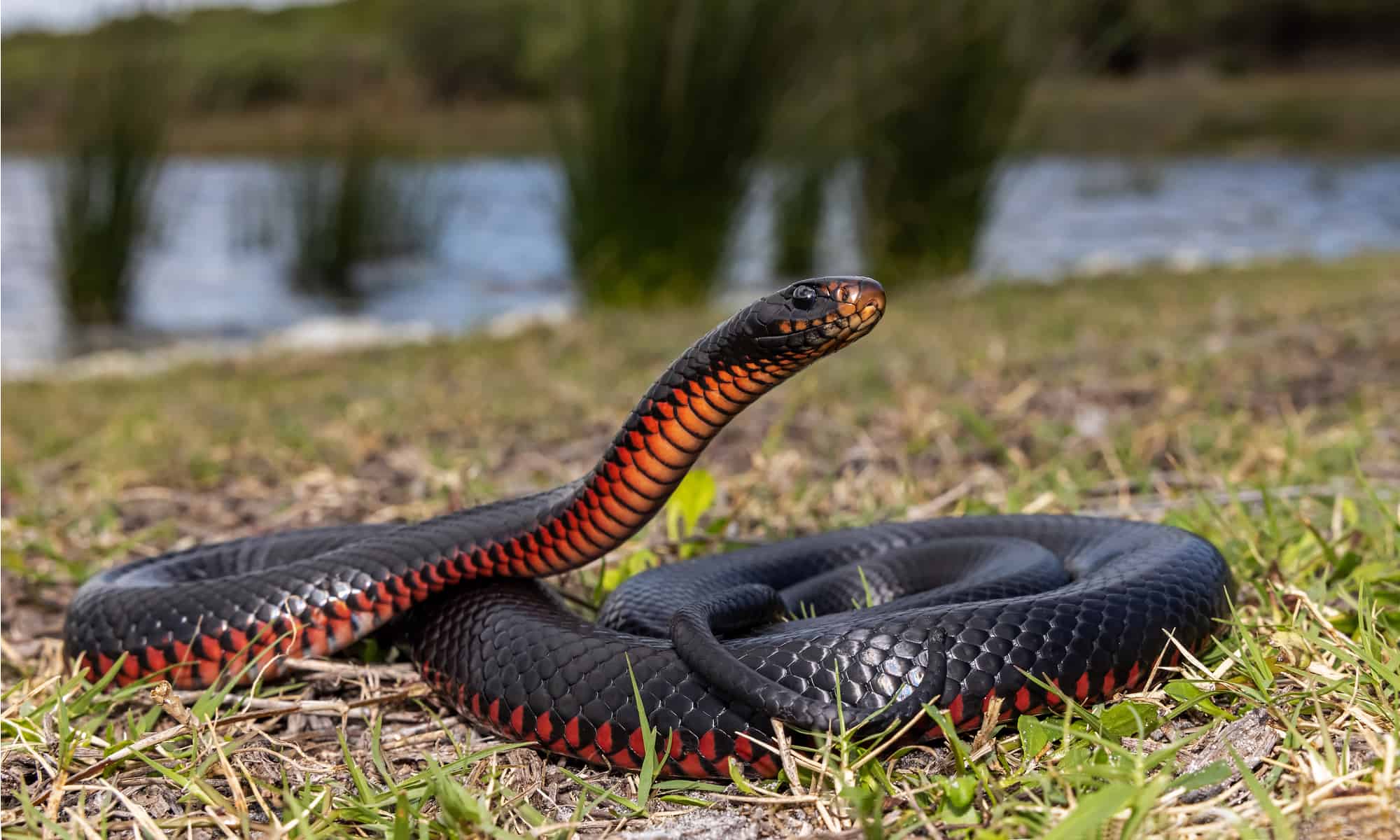
Key facts most searched about the red-bellied black snake:
- Despite being highly venomous and one of the most commonly encountered snakes in eastern Australia, no confirmed human death has ever been recorded from a red-bellied black snake bite.
- It is an unusually strong swimmer for an elapid, able to hunt underwater and reportedly stay submerged for up to 23 minutes at a time.
- The species is listed as Least Concern by the IUCN, though invasive cane toads have caused documented local population declines in parts of its range.
The red-bellied black snake is one of the most recognizable snakes in eastern Australia, instantly identifiable by its glossy black back and bright crimson underside. It is also one of the most misunderstood, often assumed to be far more lethal than the documented record actually supports. This guide covers what is confirmed about the species' venom, size, diet, habitat, reproduction, and conservation status, based on information published by the Australian Museum, Animal Diversity Web, and IUCN assessment records.
Quick Summary Table
| Category | Detail |
|---|---|
| Scientific name | Pseudechis porphyriacus |
| Family | Elapidae |
| Average adult length | 1.5 to 2 meters (about 5 to 6.5 feet) |
| Maximum recorded length | Approximately 2.5 meters |
| Coloration | Glossy black back and upper sides; red to crimson underside, often fading to cream at center |
| Venom type | Comparatively weaker elapid venom; average yield around 37 mg |
| Confirmed human deaths | None recorded |
| Diet | Frogs, fish, lizards, small mammals, birds, and other snakes |
| Reproduction | Viviparous; litters of 5 to 40 live young |
| Activity pattern | Diurnal; semi-aquatic, strong swimmer |
| Range | Eastern Australia: Queensland, New South Wales, Victoria, isolated population near Adelaide |
| Conservation status | Least Concern (IUCN); localized decline linked to cane toads |
What Is a Red-Bellied Black Snake? Naming and Classification
The red-bellied black snake was first formally described by British naturalist George Shaw in 1794 under the name Coluber porphyriacus, making it one of the earliest Australian snake species to receive a scientific description. It was later reassigned to the genus Pseudechis, which contains several closely related Australian black snake species, and its current scientific name, Pseudechis porphyriacus, has remained stable for decades despite a long history of taxonomic synonyms recorded in the literature.
The common name is a direct reference to its most obvious identifying feature, a glossy black back paired with a vivid red underside, distinguishing it at a glance from other Australian black snakes such as the blue-bellied black snake, which carries blue coloring underneath instead of red.
How to Identify a Red-Bellied Black Snake: Size and Appearance
Adult red-bellied black snakes commonly measure between 1.5 and 2 meters in length, with exceptionally large individuals recorded up to about 2.5 meters. The back and upper sides are a deep, glossy black, while the underside displays bright red or crimson coloring along the lower flanks, typically fading to cream or pale yellow toward the center of the belly. The head blends smoothly into the body with no clearly distinguishable neck, a detail that helps separate it from some similarly colored species.
Like all snakes, red-bellied black snakes lack external ears and eyelids, relying instead on vibration sensing and a permanently clear protective scale over each eye, traits shared across the entire snake lineage rather than anything unique to this species.
Red-Bellied Black Snake Venom: How Dangerous Is a Bite?
This is the single most searched question about the species, and the honest answer runs counter to its intimidating reputation. Red-bellied black snake venom is genuinely capable of causing significant illness, including pain, swelling, nausea, and blood clotting disturbances, and a bite should always be treated as a medical emergency. However, according to Animalia and multiple Australian herpetological sources, no confirmed human death has ever been recorded from this species' bite, a track record that stands in sharp contrast to several other Australian elapids.
Part of the explanation lies in venom composition. A single bite delivers an average of around 37 milligrams of venom, and researchers generally rank red-bellied black snake venom as comparatively weaker, milligram for milligram, than that of the eastern brown snake, tiger snake, or several other Australian elapids. This does not make the species harmless, since serious envenomation cases still occur and hospitalization is common, but it does explain why fatalities have not been documented despite the frequency of human encounters.
What Does a Red-Bellied Black Snake Eat? Diet and Hunting Behavior
The red-bellied black snake has one of the broadest diets of any Australian elapid, feeding on frogs, tadpoles, fish, eels, lizards, small mammals, birds, and other snakes, including venomous species such as the eastern brown snake and, on occasion, other members of its own species. It hunts actively both on land and in water, sometimes deliberately stirring up underwater sediment to flush hidden prey into the open.
Once prey is captured, it is often swallowed quickly, sometimes even before the venom has fully taken effect, a hunting efficiency that reflects the species' opportunistic and highly active foraging style compared to ambush predators like the death adder.
Can a Red-Bellied Black Snake Swim? Semi-Aquatic Behavior
The red-bellied black snake is an unusually capable swimmer for an elapid, regularly hunting with only its head above the water's surface or submerging entirely to pursue fish, frogs, and eels. Some sources report individuals remaining underwater for as long as 23 minutes at a stretch, a striking dive capability that reflects just how closely this species' ecology is tied to water. It is also a competent climber, sometimes found several meters up in trees or shrubs near its aquatic habitat.
Where Do Red-Bellied Black Snakes Live? Habitat and Range
Red-bellied black snakes are found along the east coast of Australia, with their range extending from around Cairns in far north Queensland down through New South Wales and Victoria, plus an isolated population near Adelaide in South Australia. The species stays strongly tied to water, rarely venturing more than about 100 meters from a creek, dam, swamp, or wetland, though it also occurs in rainforest, eucalypt forest, and heathland where moisture is sufficient.
As human development expands along waterways, red-bellied black snakes increasingly turn up in suburban backyards, drainage lines, and garden beds near creeks, making it one of the elapids most frequently encountered by ordinary Australians during gardening or dog walking near water.
Reproduction: Live Birth and Breeding Behavior
The red-bellied black snake is viviparous, giving birth to live young rather than laying eggs, an adaptation that allows females to actively regulate incubation temperature by basking, which is particularly advantageous in the cooler parts of the species' southern range. Mating takes place in spring, and females give birth in summer to litters ranging from as few as 5 to as many as 40 live young, a notably wide range compared to most other Australian elapid species.
Is a Red-Bellied Black Snake Aggressive?
Despite its fearsome name, the red-bellied black snake is generally shy and avoids confrontation, typically fleeing from humans rather than standing its ground. When cornered, it may flatten and raise the front portion of its body in a defensive display and strike only if it perceives no other option. Most documented bites happen when someone accidentally steps close to a hidden snake or attempts to handle it directly, rather than from unprovoked aggression, though pregnant females defending their young are considered somewhat more likely to display defensive behavior.
Is the Red-Bellied Black Snake Endangered? Conservation Status
The red-bellied black snake is listed as Least Concern on the IUCN Red List and remains one of the most commonly encountered snake species across its eastern Australian range. The primary documented threat is the invasive cane toad, since red-bellied black snakes that attempt to eat cane toads are frequently poisoned by the toad's skin toxins, a pattern that has caused measurable population declines in parts of New South Wales following cane toad invasion.
Research tracking these declines has found that in areas where cane toads have been established the longest, red-bellied black snake populations tend to stabilize over time, suggesting at least some individuals are learning to avoid cane toads as prey. Victoria, which currently has no established cane toad population, has not shown this same impact.
Red-Bellied Black Snake vs Other Australian Elapids
Red-Bellied Black Snake vs Eastern Brown Snake
The eastern brown snake carries a far more potent and fast-acting venom and accounts for a significantly larger share of serious snakebite cases and fatalities in Australia each year, while red-bellied black snake venom, though still medically significant, has never been linked to a confirmed human death. The two species also differ sharply in temperament and lifestyle, with the red-bellied black snake being shy, semi-aquatic, and prone to fleeing, compared to the more actively defensive and fast-moving eastern brown snake. Notably, the red-bellied black snake is one of the few predators documented to prey on eastern brown snakes when the opportunity arises.
Red-Bellied Black Snake vs Blue-Bellied Black Snake
These two Pseudechis species look almost identical at a glance, sharing a glossy black back and similar overall size, but the blue-bellied black snake, also called the spotted black snake, has blue rather than red coloring on its underside, along with a slightly smaller maximum length of around 1.5 meters. Range also differs somewhat, with the blue-bellied black snake more concentrated in inland parts of New South Wales and southern Queensland compared to the strongly coastal, waterway-linked distribution of the red-bellied black snake.
Frequently Asked Questions About the Red-Bellied Black Snake
Is a red-bellied black snake bite dangerous or deadly?
A red-bellied black snake bite is genuinely dangerous and can cause significant illness, but no confirmed human death has ever been recorded from its venom, according to Animalia and multiple Australian reptile authorities. Venom yield per bite averages around 37 mg, and the venom itself is considered comparatively weaker than that of several other Australian elapids such as the eastern brown snake or tiger snake. That said, medical professionals still treat every suspected bite as an emergency, since envenomation can cause serious symptoms including pain, swelling, nausea, and in some cases blood clotting problems that require hospital treatment.
How big does a red-bellied black snake get?
Adult red-bellied black snakes commonly reach 1.5 to 2 meters in length, roughly 5 to 6.5 feet, with some exceptionally large individuals recorded up to 2.5 meters. Males are generally reported to grow slightly larger than females, though this pattern is not consistently documented across every population. The snake's head blends smoothly into the body without a distinct neck, which is a useful identification detail alongside its size.
Why is it called a red-bellied black snake?
The name comes directly from the snake's two-tone coloring, a glossy solid black back and upper sides paired with a vivid red, crimson, or pink underside and lower flanks, which often fades to cream or yellow toward the center of the belly. This bold contrast between the black dorsal surface and red ventral coloring is one of the most reliable ways to distinguish this species from other black colored Australian elapids, including the visually similar blue-bellied black snake, which has blue rather than red coloring underneath.
What does a red-bellied black snake eat?
Red-bellied black snakes have an unusually broad diet for an Australian elapid, feeding on frogs, tadpoles, fish, eels, lizards, small mammals, birds, and other snakes, including venomous species such as the eastern brown snake and even other red-bellied black snakes. They hunt actively both on land and underwater, sometimes stirring up sediment to flush out hidden prey, and captured food is often swallowed quickly, occasionally even before the venom has fully taken effect.
Can a red-bellied black snake swim and how long can it stay underwater?
Yes, the red-bellied black snake is an excellent swimmer and frequently hunts in water, sometimes submerging with only its head above the surface or diving completely underwater to pursue fish, frogs, and eels. Some sources report the species can remain submerged for as long as 23 minutes at a time, an unusually long dive capability that supports its semi-aquatic hunting style near creeks, dams, swamps, and wetlands.
Where do red-bellied black snakes live in Australia?
Red-bellied black snakes are found along the east coast of Australia, ranging from around Cairns in far north Queensland down through New South Wales and Victoria, with an isolated population near Adelaide in South Australia. They strongly favor habitat close to water, including creeks, swamps, dams, and wetlands, and rarely venture more than about 100 meters from a water source, though they also turn up in rainforest, eucalypt forest, heathland, and increasingly in suburban gardens near waterways.
Does a red-bellied black snake lay eggs or give birth to live young?
The red-bellied black snake is viviparous, meaning females give birth to live young rather than laying eggs, an adaptation that lets them regulate incubation temperature directly, which is especially useful in the cooler parts of their range. Mating occurs in spring, and females give birth in summer to litters ranging from about 5 to 40 live young, a considerably wider range than most other Australian elapid species.
Is the red-bellied black snake endangered?
No, the red-bellied black snake is listed as Least Concern on the IUCN Red List and remains one of the most commonly encountered snakes in eastern Australia. The main documented threat is the spread of invasive cane toads, since red-bellied black snakes that eat cane toads are often poisoned by the toad's toxin, causing localized population declines in some invaded parts of New South Wales. Research has found that in areas where cane toads have been established longest, red-bellied black snake numbers have stabilized, suggesting some populations are learning to avoid this introduced species as prey.
Is a red-bellied black snake aggressive?
No, the red-bellied black snake is generally shy and non-aggressive, and it typically tries to flee from humans rather than confront them. When cornered or startled, it may flatten and raise its forebody in a defensive display and strike if it feels it has no other option, but most documented bites occur when a person accidentally steps near or attempts to handle the snake rather than from an unprovoked attack. Pregnant females defending offspring are considered somewhat more prone to defensive behavior than other individuals.
How does a red-bellied black snake compare to an eastern brown snake?
The eastern brown snake carries a far more potent, fast-acting venom and is responsible for significantly more serious envenomations and fatalities in Australia each year, while red-bellied black snake venom, though still medically significant, is comparatively weaker and has never been linked to a confirmed human death. Behaviorally, the two species also differ, since the red-bellied black snake is shy and semi-aquatic, while the eastern brown snake is more active, faster moving, and more likely to stand its ground when threatened. Interestingly, the red-bellied black snake is also one of the few predators known to prey on eastern brown snakes.


No comments:
Post a Comment