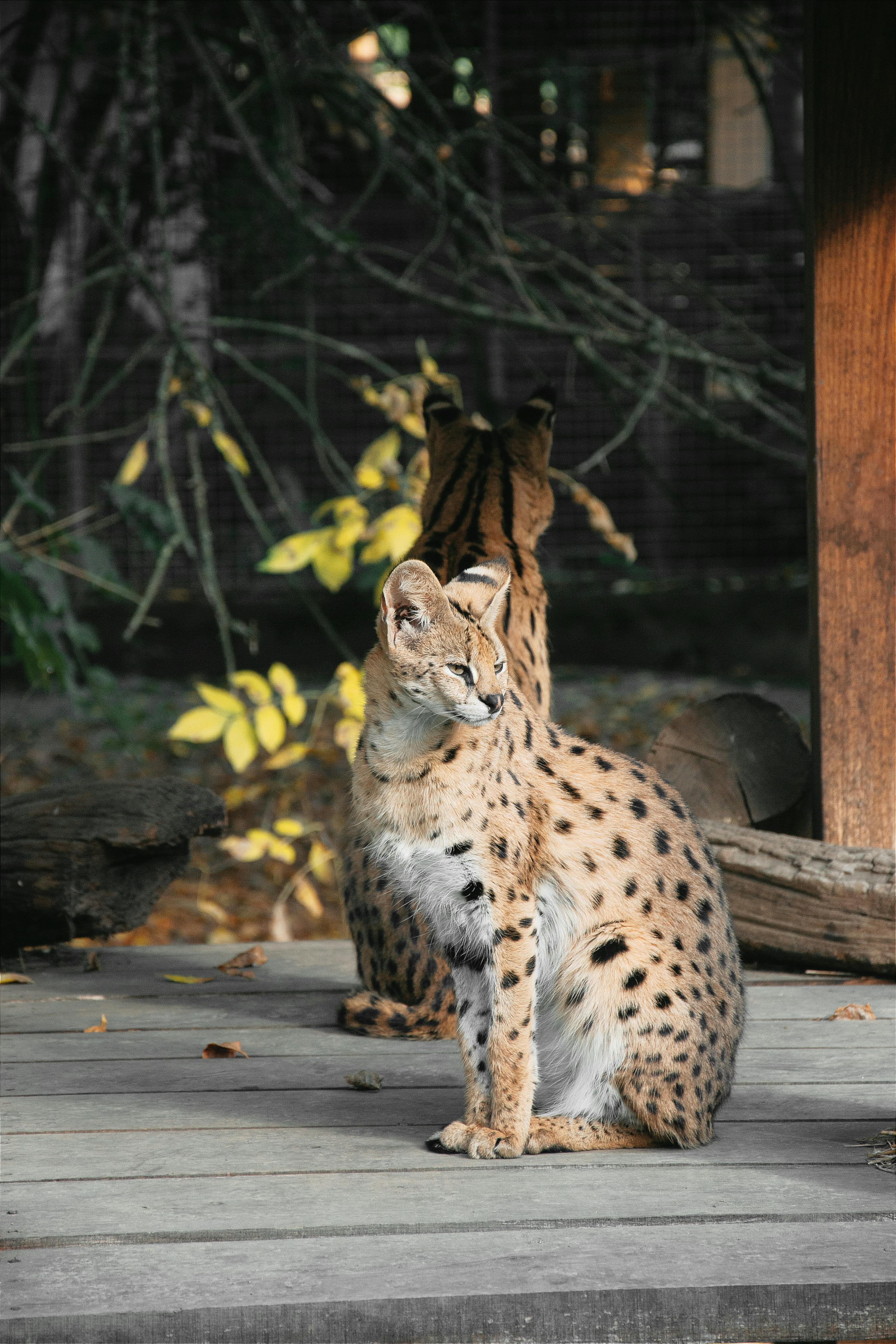
The Savannah cat is the closest thing to owning a miniature cheetah, and it is also one of the most searched, most expensive, and most misunderstood cat breeds in the world. Before you fall in love with a photo, you need real numbers: how the price changes by generation, where it is actually legal to own one, and what daily life with a Savannah really looks like.
Quick facts people search for most (key takeaways):
- Price depends almost entirely on generation. An F1 Savannah cat, the direct offspring of an African serval and a domestic cat, commonly sells for $12,000 to $20,000 or more, while an F4 or F5 Savannah typically costs $1,000 to $5,000, since later generations are easier to breed and produce.
- Every recent Guinness World Record for tallest domestic cat has gone to a Savannah. Arcturus Aldebaran Powers held the title at 48.4 cm, and the record has stayed inside this breed for years, which is exactly why so many people search "tallest domestic cat breed."
- Savannah cat ownership is not legal everywhere. States such as Georgia, Hawaii, Nebraska, and Rhode Island restrict or ban ownership outright, and several other states only allow F4 or later generations, which makes "is a Savannah cat legal in my state" one of the most practical questions a buyer can ask before purchasing.
Savannah Cat Summary Table
| Generation | Serval Ancestry | Typical Price (USD) | Temperament Notes |
|---|---|---|---|
| F1 | Parent is a purebred serval | $12,000 to $25,000 | Tallest, wildest, most independent, needs an experienced owner |
| F2 | Serval grandparent | $6,000 to $12,000 | Still very large and energetic, strong prey drive |
| F3 | Serval great grandparent | $3,500 to $9,000 | More balanced, better fit for homes with older children |
| F4 | Serval great great grandparent | $1,500 to $6,000 | Closer to a large domestic cat in behavior |
| F5 and beyond | Minimal direct serval lineage | $1,000 to $5,000 | Most social and predictable, legal in the most states |
What Is a Savannah Cat?
A Savannah cat is a hybrid breed created by crossing an African serval (Leptailurus serval) with a domestic cat. The first documented Savannah was born in 1986, and the breed was officially recognized by The International Cat Association in 2001. Savannah cats are known for their long legs, oversized ears, bold spotted coat, and a build that makes them look far closer to a wild cat than any other domestic breed.
Adult Savannahs can weigh anywhere from 6 to 10 kg and measure up to 1.2 meters in length in early generations, which makes them one of the largest cat breeds in the world alongside the Maine Coon.
Savannah Cat Price by Generation (F1 to F5)
The price of a Savannah cat is driven almost entirely by how close the cat is to its wild serval ancestor. An F1 Savannah cat, the direct offspring of a serval and a domestic cat, is the most expensive tier and typically costs $12,000 to $25,000, since male Savannahs are usually infertile through the F4 or F5 generation, forcing breeders to keep crossing back to servals to maintain supply.
F2 Savannahs, with a serval grandparent, usually range from $6,000 to $12,000. F3 Savannahs typically cost $3,500 to $9,000 and are often recommended for buyers who want the exotic look with a more manageable temperament. F4 and later generations, including F5 and beyond, are the most affordable and the most common choice for first time owners, generally priced between $1,000 and $6,000.
Beyond generation, price also depends on sex (early generation females often cost more because most early generation males are sterile), coat markings, TICA registration, health testing, and whether the kitten is sold as a pet or with breeding rights.
Is a Savannah Cat Legal in Your State?
Savannah cat legality in the United States is decided state by state, and sometimes county by county, so checking local rules before buying is essential. Georgia, Hawaii, Nebraska, and Rhode Island are commonly cited as states that ban or heavily restrict Savannah cat ownership. Several other states, including Alaska, Iowa, Massachusetts, New Hampshire, and Vermont, only allow F4 generation or later. New York generally permits F5 and beyond, though cities such as New York City and Denver, Colorado prohibit Savannah cats regardless of generation.
Texas restricts ownership in most counties, with only a handful, including Harris, Bell, and Guadalupe, allowing Savannahs under strict permitting rules. Outside the United States, the United Kingdom requires a special licence to own a serval or an F1 Savannah cat, and several other countries impose their own generation based restrictions. Always confirm current rules with your state or county animal control office before committing to a purchase, since these laws are updated over time.
Savannah Cat Size Records and Guinness World Records
The Savannah cat holds a remarkable streak in Guinness World Records history: the last several titleholders for tallest domestic cat have all been Savannahs. Arcturus Aldebaran Powers, an F1 Savannah from Michigan, was verified at 48.4 cm (19.05 inches) tall in 2016, and Fenrir Antares Powers, his brother and an F2 Savannah, later carried the title of tallest living domestic cat. Scarlett's Magic, another F1 Savannah, held the record before Arcturus. This consistent dominance is why the Savannah is frequently the answer to searches like "tallest cat breed in the world."
Savannah Cat Temperament and Daily Care
Savannah cats are highly intelligent, playful, and famous for dog like behavior: many can be leash trained, learn to fetch, and some genuinely enjoy water. Early generations (F1 to F3) carry a stronger prey drive, need large enrichment spaces, and can jump up to 2.5 meters, so they are generally not recommended for small apartments or homes with small pets. F4 and later generations tend to be calmer, more social with children, and easier to integrate into an average household.
Because of their wild ancestry, Savannah cats often need a diet higher in taurine and benefit from a veterinarian experienced with hybrid breeds. With proper care, Savannah cats can live up to 18 years or more.
Conclusion: Should You Get a Savannah Cat?
A Savannah cat can be an incredible companion for the right owner: active, intelligent, and strikingly beautiful. But the breed is not a casual purchase. Before buying, confirm the generation, verify it is legal in your state or country, and choose a reputable breeder who provides health testing and TICA documentation. If you want the look without the higher price and legal complexity, an F4 or F5 Savannah is usually the most practical choice for a first time owner.
Frequently Asked Questions About the Savannah Cat Breed
How much does a Savannah cat cost by generation?
An F1 Savannah cat, the direct offspring of an African serval, usually costs $12,000 to $25,000. Prices drop with each generation: F2 runs $6,000 to $12,000, F3 runs $3,500 to $9,000, and F4 or later generations typically cost $1,000 to $6,000.
Is it legal to own a Savannah cat in my state?
It depends on the state. Georgia, Hawaii, Nebraska, and Rhode Island commonly ban or heavily restrict Savannah cat ownership, while states like New York, Massachusetts, and Iowa only allow F4 or F5 generations and later. Always confirm with local animal control before buying, since city level rules can be stricter than state law.
What is the tallest cat breed in the world?
The Savannah cat holds this title through multiple Guinness World Records. Arcturus Aldebaran Powers, an F1 Savannah, was measured at 48.4 cm tall in 2016, and other record holders, including Fenrir Antares Powers and Scarlett's Magic, were also Savannah cats.
What is the difference between an F1 and F5 Savannah cat?
An F1 Savannah cat has a purebred African serval as one parent, making it the largest, wildest, and most expensive generation. An F5 Savannah cat is five generations removed from the serval, is smaller, calmer, more social, and legal to own in far more states.
Are Savannah cats dangerous to own?
No, Savannah cats are not considered dangerous, and there are practically no documented reports of attacks on owners. However, early generations (F1 to F3) have a strong prey drive and high energy, so they require experienced handling and are not ideal around very small pets.
How big do Savannah cats get?
Early generation Savannah cats can reach up to 1.2 meters in length and weigh between 6 and 10 kg, making them one of the largest domestic cat breeds. Later generations, F4 and beyond, are noticeably smaller but still larger than an average house cat.
Do Savannah cats need a special permit?
In many states and countries, yes. Early generation Savannah cats (F1 to F3) often require a wild or exotic animal permit, and in the United Kingdom, owning a serval or an F1 Savannah cat legally requires a special licence.
Why are Savannah cats so expensive compared to other cat breeds?
Savannah cats are expensive mainly because male Savannahs are usually infertile until around the F5 generation, forcing breeders to repeatedly cross back to servals to produce new F1 kittens, which keeps supply low and prices high, especially for F1 to F3 generations.
Data source:
savannahcatassociation.org
hepper.com
guinnessworldrecords.com
a-z-animals.com
catster.com
f1savannahkittens.com


No comments:
Post a Comment